A naval blockade would be extremely costly for the United States
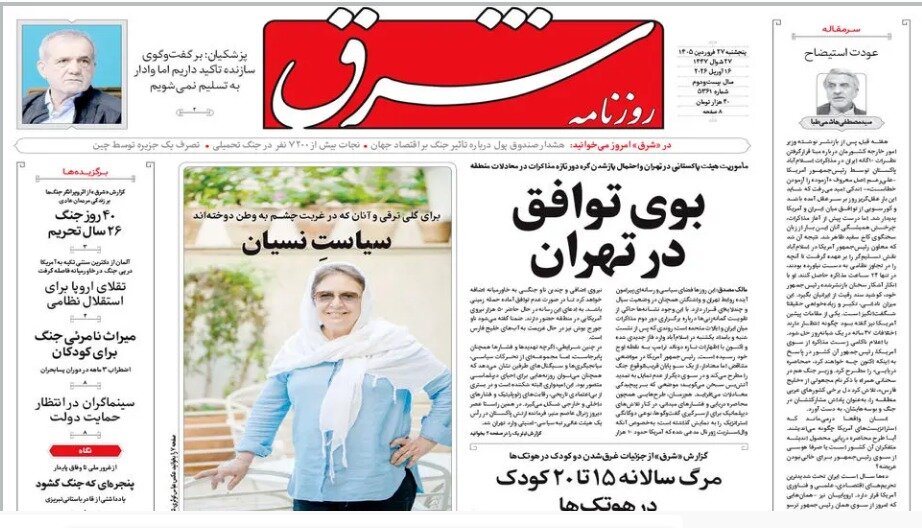
Shargh, in an editorial, examined the prospect of the US naval blockade against Iran. Announcing a ‘naval blockade’ is, in fact, a clear sign of retreat. Suppose the United States decides to target every ship in the Indian Ocean and the Sea of Oman that is heading to or departing from Iran, and Iran offers no response, allowing the mission to succeed.
Is the sea route really Iran’s only breathing channel? The country’s domestic capacities are so extensive that, if used properly, many needs can be met internally. Moreover, Iran shares thousands of kilometers of land borders with multiple countries. Therefore, a naval blockade would not only be the least effective measure against Iran, but it would also impose a very high cost on the United States.
Arman‑e-Melli: Diplomatic visits
Arman‑e-Melli, in its commentary, discussed the visit of Pakistan’s Chief of Defense Forces (CDF) Field Marshal Syed Asim Munir, aimed at consultations with Iranian officials. Pakistani officials have recently pursued an active diplomatic agenda by traveling to Iran and Saudi Arabia to help create conditions for the resumption of negotiations. Asim Munir traveled to Iran to advance Islamabad’s negotiations and encourage Tehran to continue the talks. Pakistani analysts say that these significant visits by the country’s political and military leaders to the region signal a glimmer of hope for extending the current temporary ceasefire between Iran and the United States. Of course, the ceasefire in Lebanon is also a positive indicator for Iran’s decision regarding the next round of negotiations. However, the United States must adhere to a logical framework for the talks and avoid excessive demands or repeating the breaches it committed before the ceasefire, which would obstruct progress.
Iran: A golden opportunity for Iran and China
In the recent West Asia crisis, China demonstrated that its approach to regional dynamics—contrary to common assumptions—is neither ideological nor based on military presence. Instead, it is shaped around geo‑economics, pragmatic diplomacy, and strategic patience, and this creates a valuable opportunity for Iran in shaping the future of Tehran–Beijing relations. Hamed Vafaei, a scholar of Chinese studies, explained China’s three‑stage strategy for playing a role in the recent conflict in an interview with the Iran newspaper. Without incurring any military cost and relying solely on economic leverage and quiet diplomacy, China managed to secure its energy supply, accelerate the process of de‑dollarization and the rise of the petro‑yuan, and reinforce its credibility as an effective regional mediator. Iran, by using the Strait of Hormuz card, can elevate China from a mere economic partner to a diplomatic anchor and a balancing force against pressure from Trump. Iran can also use China’s newly strengthened diplomatic standing to raise the issue of stability in the Strait of Hormuz at the upcoming Xi Jinping –Trump summit.
Etemad: The efforts of Iranian diplomats are a continuation of the military achievements
Etemad discussed Iran–US negotiations after the ceasefire in an interview with political figure Fatemeh Rakei. According to this analyst, although the other side demanded a two‑week ceasefire, a new arena of confrontation has now opened. This time, the commanders of Iran’s diplomatic corps have become ready to face the other side. Just as all national capacities were mobilized to support soldiers and military commanders on the defensive front, all of the country’s capabilities and resources must now be deployed to ensure the success of the diplomats. Any weakening of diplomacy runs counter to national interests and undermines the country’s potential. Every diplomatic decision is made with the approval of responsible institutions at the highest levels of state and government. Therefore, personal remarks or views that contradict national interests must not send the signal abroad that Iran lacks a unified voice regarding either the battlefield or diplomacy.
Khorasan: China will not back down in confrontation with Trump
It is evident that the United States is changing the way it engages with the world, and in doing so, it shows no hesitation about reshaping the international order itself. This is precisely the danger point that has pushed China, for some time now, into a phase of confrontation with the United States. In reality, China does not seek a confrontation with the US, and even before recent developments, despite continuing to operate within a unipolar system, it had already found itself in direct opposition to Washington on numerous issues — such as the Russia–Ukraine war, helping Iran circumvent sanctions, and vetoing recent UN Security Council resolutions against Iran. China will certainly not allow its oil lifelines to be cut so easily. Even now, a list of mechanisms to sustain Iran–China cooperation in energy supply and trade — centered on bypassing Trump’s new sanctions model — is being put into action.
Leave a Comment